

Conditions · evidence guide
Hyperbaric Oxygen Therapy After Surgery: What the Evidence Shows
A hyperbaric chamber after surgery is not an FDA-cleared recovery treatment, and no insurer pays for one. The Cochrane review calls the evidence for surgical wounds unclear. The best recent trial found an early benefit that was gone by two weeks. And one exception carries full regulatory backing: rescuing a failing skin graft or flap. Here is the full record, study by study, before you buy a package.
The short answer
Three verdicts, one page
"Hyperbaric chamber after surgery" blends three very different claims into one search. Separating them is the whole story: the one cleared and covered use, the thin evidence for routine recovery, and a cosmetic-surgery market that sells far ahead of its data.
The one cleared, covered use: rescuing failing tissue
When a skin graft or flap starts failing after reconstructive surgery, HBOT is FDA-cleared, UHMS-listed (indication #12), and Medicare-covered as a surgeon-directed salvage adjunct. In the classic series of 105 patients, 89% of threatened flaps and 91% of threatened grafts were salvaged, and starting early made the difference. This is the strongest post-surgical use that exists, and it is not a wellness service.
Routine recovery: thin, mixed, and mostly transient
For an otherwise normal recovery, the Cochrane review of acute surgical wounds calls the evidence unclear (4 trials, 229 participants, all at risk of bias). The best recent trial, 80 knee replacements, found less swelling, pain, and muscle damage on days 2 to 3, and no difference by day 14, using just two sessions at an unusually low 1.6 ATA. The largest pooled analysis in plastic surgery found fewer complications that did not reach statistical significance.
The cosmetic-surgery market runs ahead of the data
Facelift, tummy tuck, and liposuction recovery packages are a growing med-spa business built on the weakest study designs: a 20-patient facelift case-control, a 296-patient aesthetic series with no control group whose own authors say they could not prove effectiveness, and a meta-analysis that pools heterogeneous protocols and demands real trials. None of this is FDA-cleared or insured, and the marketing is years ahead of the evidence.
Two disclosures frame everything below, and they belong at the top. First, HBOT is not FDA-cleared or approved for general surgery recovery: the cleared indications cover wounds, carbon monoxide poisoning, decompression sickness, compromised grafts and flaps, and nine other conditions, and ordinary post-operative healing is not among them (FDA, archived; UHMS indications). Every recovery package sold to a post-op patient is off-label. Second, neither Medicare nor commercial insurers pay for recovery use (NCD 20.29), which makes this a cash market aimed at people in the most motivated weeks of their lives, and those people deserve the whole record, not the highlight reel. New to the therapy itself? Start with how hyperbaric oxygen therapy works.
If something is going wrong after your surgery, this page is not for that moment. Fever, spreading redness, a wound that is opening or leaking, sudden swelling, or pain that is getting worse instead of better: call your surgical team. Those are post-operative warning signs, and the clock on them is measured in hours, not in wellness appointments. A failing graft or flap is a surgical emergency where HBOT, when it is used at all, is started by the surgical team inside an hours-to-days window, not booked by the patient (Bowersox 1986). And the rule that overrides everything else on this page: HBOT never replaces or delays standard post-operative care. It is, at best, an adjunct that your surgeon agrees to.
Why oxygen became the hypothesis
The rationale, in one honest paragraph
The mechanism story is genuinely plausible. It is also the story every recovery package leads with, so we keep it short and grade it against trials in the next section.
Surgery is controlled trauma. Even when everything goes well, the operated tissue swells, inflammation rises, and local circulation is temporarily disturbed, so oxygen demand goes up exactly where oxygen delivery goes down. Breathing 100% oxygen under pressure dissolves extra oxygen directly into blood plasma, enough to reach tissue past swollen, compromised microcirculation. That is the entire pitch, and it is not fantasy: hyperbaric oxygen measurably raises tissue oxygen tension, supports fibroblast function and new vessel growth, and interrupts the ischemia-reperfusion cascade that damages tissue when blood flow returns to a starved flap (Francis and Baynosa 2017; Zamboni 1993).
The honest nuance is where that rationale concentrates. A mechanism that rescues oxygen-starved tissue argues loudest for tissue that is actually oxygen-starved: a failing flap, a graft that is not taking, a wound sliding toward necrosis. A normal recovery, where swelling peaks and resolves on schedule, is a much weaker target, because the tissue is not the bottleneck. This is why the serious literature keeps drawing the same line this page draws: compromised tissue is a medical question, routine recovery is an open one.
The full mechanism story, and the hopeful side of this literature told properly, lives in our post-surgical recovery evidence guide. This page exists to grade it. For the condition where the same oxygen-delivery logic is established, covered, and guideline-backed, see the sibling wound healing and HBOT pillar.
The citations
The evidence, study by study
Every load-bearing claim on this page, mapped to the study behind it. The mixed and negative rows lead, because every recovery-package page puts them last or nowhere.
| Study | Design & population | Protocol | What it found | Level |
|---|---|---|---|---|
| Eskes et al. 2013 (Cochrane) Cochrane Database Syst Rev | Systematic review, 4 RCTs, 229 participants, acute surgical and traumatic wounds; too heterogeneous for meta-analysis | HBOT vs usual care, sham, or other agents; protocols varied (1.5-2.5 ATA) | Two small positive trials (skin grafts in burns, crush injuries), two null. All four at unclear or high risk of bias. Verdict: a lack of high-quality, valid research evidence; routine use cannot be recommended | Cochrane review |
| Molina-Vega et al. 2026 PRS Glob Open | Systematic review, 18 studies, 1,281 patients (786 HBOT, 495 controls), plastic surgery indications 1967-2023; two-thirds case series, only 2 RCTs | Mostly 90-120 min at 2.0-2.5 ATA; salvage protocols twice daily early | Pooled complication odds ratio 0.48 in favor of HBOT but NOT significant (95% CI 0.09-2.66, p=0.40, I2 82%). Flap/graft survival 64-100% across series. Authors: apply selectively, not routinely; standardized RCTs needed | Systematic review (ns) |
| Boet et al. 2020 Eur J Anaesthesiol | Systematic review of preventive peri-operative HBOT RCTs | Pre- and post-operative HBOT across surgical types | Evidence for routine preventive peri-operative HBOT is limited and heterogeneous; no solid basis for broad prophylactic use | Systematic review |
| Zhang et al. 2025 Sci Rep | Single-center RCT, 80 primary total knee arthroplasty patients (38 HBOT completers, 40 control, 2 dropouts), China | Only 2 sessions (24 h and 48 h post-op) at 1.6 ATA, 100% O2, vs normobaric oxygen by nasal cannula | Day 2-3: less muscle damage (CK, myoglobin), lower CRP/IL-6, less swelling and pain, better range of motion and quadriceps strength. ALL differences gone by day 14 and weeks 6-12; no adverse-event difference. A real but short-lived early benefit at an unusually low dose | Positive RCT (transient) |
| Perrins 1967 Lancet | RCT, 48 burn patients undergoing split skin grafting (24 HBOT, 24 usual care) | Twice-daily sessions at 2.0 ATA, 6 total | Complete graft survival 64% with HBOT vs 17% without. The oldest positive randomized result in the field, rated "some concerns" for bias in the 2026 review; burn grafts, not elective-surgery recovery | Positive RCT (old) |
| Bowersox et al. 1986 J Hyperbaric Med | Retrospective series, 105 patients with threatened flap or graft failure, 93 analyzed (67 flaps, 35 grafts), no control group | Monoplace chambers at 2.0 ATA, 100% O2, twice daily then daily, mean 16 postoperative treatments | 89% of threatened flaps and 91% of threatened grafts salvaged, most with poor prognostic factors. Failed flaps started HBOT 15 days later than salvaged ones (19.8 vs 4.6 days): early initiation decides. 15 ear barotrauma, 1 seizure in a patient with a seizure history | Retrospective series |
| Dauwe et al. 2014 Plast Reconstr Surg | Systematic review, 8 studies of level III evidence or better, complicated acute wounds, flaps, and grafts | HBOT plus standard wound management across plastic-surgery indications | HBOT can augment healing in COMPLICATED acute wounds combined with standard care; use in NORMAL wound management is not indicated; more trials needed before it becomes a mainstay | Systematic review |
| Friedman et al. 2019 PRS Glob Open | Retrospective cohort, 356 abdominoplasty patients; 83 chose preoperative HBOT, 273 comparison; self-selected, single center | 1-3 preoperative sessions of 90 min at 2.0 ATA | Complications 8.4% with preconditioning vs 32.6% without (OR 0.182, p<0.001); necrosis 0% vs 6.2%. Promising, but patients chose and paid for HBOT, the dose varied from 1 to 3 sessions, and the authors call for prospective corroboration | Retrospective cohort |
| Neel et al. 2023 Aesthet Surg J Open Forum | Retrospective case-control, 20 female facelift patients (9 HBOT, 11 controls), one surgeon, one private practice | Mean 7 sessions of 60-90 min at 2.0 ATA, first session within 24 h of surgery | Time to wound healing 13.3 days with HBOT vs 36.9 days without (p<0.001); no barotrauma. The only facelift-specific comparative study, and it is 20 unrandomized patients from one practice; the authors themselves demand larger randomized trials | Case-control (tiny) |
| Simman and Bach 2022 Eplasty | Case series, 4 patients, no control group: filler-induced necrosis (2), a non-healing post-abdominoplasty wound, a failing Mohs reconstruction flap | 5-39 sessions at 2.5 ATA alongside standard wound care, debridement, and negative-pressure therapy | All four wounds healed. The authors concede the patients may have healed with wound care alone. Illustrates where clinicians actually reach for HBOT: threatened or stalled tissue, not routine recovery | Case series |
| Aguilar et al. 2024 PRS Glob Open | Retrospective descriptive series, 296 aesthetic-surgery patients (liposculpture, abdominoplasty, breast), one practice in Colombia, NO control group | 5 daily sessions of 45 min at 2.0 ATA starting 24 h post-op, sold as a roughly $50/session add-on | Complications 10.7%, zero infections, quick return-to-work times. The authors state plainly: "We could not prove that the HBOT is effective for the postoperative process due to the methodological limitations." The documented med-spa model, with the honest caveat printed in the paper itself | Case series (no control) |
| Mortada et al. 2025 Aesthetic Plast Surg | Systematic review and meta-analysis, 11 studies, 734 patients (416 received HBOT), mostly abdominoplasty and breast aesthetic surgery | 45-120 min at 2.0-3.0 ATA, used postoperatively in 91% of studies | Pooled mean healing time 11.3 days in HBOT groups; early satisfaction up to 88.2%. The most favorable pooled read of the cosmetic literature, built on heterogeneous designs; the authors conclude that well-designed RCTs are needed before standardized recommendations | Meta-analysis |
PMIDs, DOIs, and links for every row are in the sources card. The synthesis: the salvage literature (threatened grafts and flaps) is consistent but old and uncontrolled; the routine-recovery literature is thin, with the strongest pooled effect failing to reach significance and the best single trial showing a benefit that faded by two weeks; and the cosmetic literature is the weakest of the three while supporting the loudest marketing. That is the state of the evidence in October 2026, and any page telling you otherwise is selecting its studies.
The salvage-versus-recovery line, explained
One distinction organizes the entire table. Salvage means tissue is actively failing: a flap turning dusky, a graft not taking, a wound breaking down. There, the oxygen rationale is strong, the regulatory triad agrees (cleared, listed, covered), and the clinical series point the same direction, with early treatment deciding outcomes. Recovery means the operation went fine and the patient wants the normal healing process to go faster. There, the tissue is not oxygen-starved, no regulator or payer recognizes the use, and the evidence is the Cochrane "unclear," a transient two-session effect, and uncontrolled cosmetic series. The UHMS draws this exact line in its own indication text: HBOT is "neither necessary nor recommended for the support of normal, uncompromised grafts or flaps". Medicare draws it too: coverage is for compromised grafts, "not for primary management of wounds". When a clinic quotes salvage numbers to sell recovery packages, it is crossing the line both bodies wrote down.
Why the cosmetic numbers cannot be taken at face value
The recovery-after-cosmetic-surgery numbers look impressive until you ask the design question. Post-surgical healing is a process that completes on its own in nearly every patient, so any treated group will show healing, and any treated group will swear by the treatment. Add that the patient paid extra for the chamber, was told it would help, and wants it to have worked, and expectancy does the rest. That is what the no-control series (Aguilar 2024, whose authors concede they could not prove effectiveness) and the 20-patient before-and-after comparison (Neel 2023) cannot exclude. It is the same methodological fight the stroke literature went through: years of positive uncontrolled series, then a sham-controlled trial that could not reproduce the benefit. Cosmetic recovery has not yet had its sham-controlled trial at all.
Before anyone books you a session
Safety after recent surgery
HBOT has a real but manageable safety profile. A person days or weeks out of an operation is not the standard wellness client, though, and the screening questions change. This section comes before anything commercial on this page on purpose.
The common side effects are mundane: ear barotrauma during compression is the most frequent problem in every dataset, reported in up to 43% of patients across the plastic-surgery literature, mostly mild and self-limiting (Molina-Vega 2026), plus sinus pain, fatigue, temporary vision changes across long courses, and claustrophobia in single-person chambers. The serious but rare risk is an oxygen-toxicity seizure, and the one absolute contraindication is an untreated pneumothorax (Heyboer 2017). In the classic salvage series of 105 patients, the single neurological event was a seizure in a patient with a known seizure history, who went on to finish treatment (Bowersox 1986).
Recent surgery adds its own list, and this is where a med-spa intake form is not enough. Ear, sinus, head, neck, and ENT surgery can make pressure equalization difficult or unsafe while tissue heals, and equalizing is not optional in a chamber. Recent chest surgery or any lung procedure raises the trapped-air question directly, because the absolute contraindication is a pneumothorax. Drains, negative-pressure wound devices, implanted hardware, and surgical implants each need a device-specific answer from the surgical team and the hyperbaric physician, not a guess at a front desk. Medication changes, anemia, and infection are routine in the post-op window and belong in a physician's review. The summary that matters: in the weeks after an operation, HBOT screening is the surgical team's job, done with your operative note in hand. The full general picture is in our chamber safety guide and the side effects and contraindications guide.
And once more, because it is the sentence this market needs most: never delay, skip, or substitute standard post-operative care for chamber sessions. Follow-up appointments, wound checks, prescribed antibiotics, compression garments, activity restrictions: those are the recovery. Everything else on this page is, at best, an adjunct to them.
Bucket A, the anchor
The one cleared use: compromised grafts and flaps
Between "routine recovery" (unproven) and "medical emergency" (not HBOT's role) sits a third scenario with a completely different footing: a graft or flap that is actively failing. Here, the FDA, the UHMS, and Medicare all say yes.
A skin graft is tissue fully detached from its blood supply, surviving on what it absorbs from the wound bed until new vessels grow in. A flap keeps its own blood supply, which can be kinked, clotted, compressed, or simply inadequate. Either becomes compromised when oxygen delivery falls below what the tissue needs: venous congestion, arterial insufficiency, an irradiated wound bed, ischemia-reperfusion injury after free tissue transfer. The clock is measured in hours to days, and the alternative to salvage is usually debridement and a second operation. This is reconstructive-surgery territory: post-mastectomy flaps, Mohs reconstruction, free flaps after cancer surgery, and occasionally a cosmetic-surgery wound that breaks down.
The regulatory position is unusually aligned. The FDA's cleared indications include skin graft flap at risk of tissue death. The UHMS lists compromised grafts and flaps as indication #12. Medicare's NCD 20.29 covers the preparation and preservation of compromised skin grafts. The evidence, summarized in the table above, is consistent in direction: in the largest early series, 89% of threatened flaps and 91% of threatened grafts were salvaged, and the single strongest predictor was starting early, 4.6 days to treatment in the salvaged group versus 19.8 in the failures (Bowersox 1986). The honest caveats: the series are old, mostly uncontrolled, and the two systematic appraisals (Dauwe 2014; Friedman 2006) both call for modern randomized trials.
Salvage protocols are intensive and physician-directed: 2.0-2.4 ATA, 90 to 120 minutes on 100% oxygen, twice daily for the first two to three days, then daily as the tissue stabilizes, for a typical total of 20-30 sessions (Bhutani and Vishwanath 2012). That is a hospital or dedicated-clinic workflow under a hyperbaric physician's orders alongside the surgical team. The full evidence walkthrough lives in our skin grafts and flaps evidence guide, the billing side in the CPT 99183 and G0277 guide, and the broader covered-wound picture in the wound healing pillar. What this page adds is the boundary: none of it transfers to a normal recovery, and both the UHMS and Medicare say so in writing.
Bucket C, the market
Facelift, tummy tuck, lipo: the recovery-package market
This is where most "hyperbaric chamber after surgery" searches actually land: med spas and aesthetic clinics selling recovery packages to elective-surgery patients. It deserves its own honest look, because the market is large and the evidence is the thinnest on this page.
The commercial model is real and documented. In the one published practice description, a Colombian aesthetic clinic bundles five daily 45-minute sessions at 2.0 ATA, starting 24 hours after surgery, sold as an add-on at roughly $50 a session, across 296 liposuction, tummy tuck, and breast patients (Aguilar 2024). Complications were low and recoveries quick. The same paper contains the two sentences every buyer should read: the authors "could not prove that the HBOT is effective" because of their methods, and they note the practice "has become popular... based on empirical knowledge rather than adequate scientific evidence." That is the entire med-spa recovery market, described by its own literature.
The comparative data is one step better and still weak. The facelift case-control study found wounds healing in 13.3 days with HBOT versus 36.9 without, but it is 20 unrandomized patients from a single surgeon's practice, measured without blinding (Neel 2023). The abdominoplasty preconditioning cohort found complications falling from 32.6% to 8.4% in patients who chose one to three preoperative sessions, but those patients self-selected, the dose varied, and the design is retrospective (Friedman 2019). The 2025 meta-analysis pools a mean healing time of 11.3 days and satisfaction up to 88.2% across 734 patients, while concluding that well-designed randomized trials are needed before standardized recommendations (Mortada 2025).
The honest summary for a patient with a facelift or tummy tuck on the calendar: the physiology is plausible, the early numbers are interesting, the designs are the weakest in medicine, and the treatment is off-label and cash-pay. If you and your surgeon want to try it, that is a legitimate shared decision. What is not legitimate is the marketing version, where "studies show faster healing" means 20 unrandomized patients, and where nobody mentions that the treatment has never been tested against a sham anywhere in cosmetic surgery.
The decision math
What a course actually involves
There is no standardized recovery protocol, which means every package is its own claim. Here is what the published numbers look like, so you can compare any offer against them.
The protocols, in numbers
The published doses scatter so widely that "a course of HBOT" is meaningless without the numbers attached. Salvage of a failing graft or flap: 20-30 sessions at 2.0-2.4 ATA, 90-120 minutes, twice daily at first, under a hyperbaric physician. The knee-replacement trial: 2 sessions at 1.6 ATA, full stop. Aesthetic recovery packages in the literature: 5 to 10 sessions at 2.0 ATA, 45-90 minutes each, starting the day after surgery. The facelift study's authors state plainly that no agreed session count exists. When a clinic sells you a number, ask which protocol it is extrapolated from.
The money, in the open
Off-label recovery use is cash-pay everywhere. The 2026 plastic-surgery review reports per-session prices of $150-650 in the literature, which puts a 10-session package at $1,500-6,500 before any facility markup (Molina-Vega 2026). The documented add-on model ran much cheaper abroad, roughly $50 a session, which tells you the price tracks the market, not the cost of oxygen. The protective rules are the same as everywhere in this market: get the total itemized cost in writing before the first session, ask what happens to the balance if you stop early, and be suspicious of any package priced to be paid in full up front, especially one sold in the emotional first days after an operation. How coverage works for the indications that are covered is mapped in our insurance coverage guide.
The timing question, honestly
Vendor advice here is borrowed from the salvage literature, where earlier is genuinely better because tissue is dying on a clock. Routine recovery has no such clock and no studied optimal start time; the aesthetic protocols start at 24 hours because that is what the practices chose, not because a trial compared start times. Urgency, in other words, is a sales tool in this market. The one real timing fact cuts the other way: normal post-surgical swelling and bruising resolve on their own in days to weeks, which is exactly why a modest, short-lived effect is so hard to distinguish from doing nothing.
The market in numbers
The recovery market, in four numbers
Four figures from the studies and reviews already cited on this page, pulled forward so you can compare any package offer against them. Attributions: Molina-Vega 2026 for the first three, Mortada 2025 for the last.
- $150-650
- per-session price, reported range
- OR 0.48
- pooled complication ratio, not significant
- 43%
- peak ear barotrauma rate
- 11.3 days
- pooled mean healing time

The equipment side
Who buys chambers for post-op programs
Plastic-surgery clinics, med spas, and wellness centers are building post-operative recovery programs, and the equipment class behind the published protocols is a narrow, factual question. Here is the dose, then the hardware category, with zero outcome claims attached.
Every protocol in the evidence table ran on hard-shell chambers delivering 100% oxygen at 1.6 to 3.0 ATA: the salvage literature at 2.0-2.5 ATA, the aesthetic studies at 2.0 ATA, even the knee trial at 1.6 ATA. Dissolved plasma oxygen, the mechanism behind every claim in this market, scales with that pressure. Soft portable chambers operate around 1.3 ATA, typically concentrator-fed, with FDA clearance for acute mountain sickness only: they cannot reach the pressure class any of these studies used. Our own soft-shell S1 (1.3-1.5 ATA, concentrator-fed) sits in that class, and we do not present it as post-surgical equipment. The engineering and regulatory details live in our medical-grade chambers explainer, the ATA pressure guide, and the soft-shell chamber guide.
For an operator scoping a post-op recovery or aesthetic program, the equipment-class takeaway is narrow: the studied pressures sit in hard-shell, medically engineered territory, with certified pressure vessels, documented oxygen delivery, and trained oversight, and the compliance section below is the other half of that decision. The single-person rung of that class in our lineup is the Superhuman L1 (2.0 ATA hard-shell, from $49,900), with the two- and four-person models shown below. Our chambers are built to that engineering class, which is the only claim we make here, and it is a claim about hardware, not about surgical outcomes.
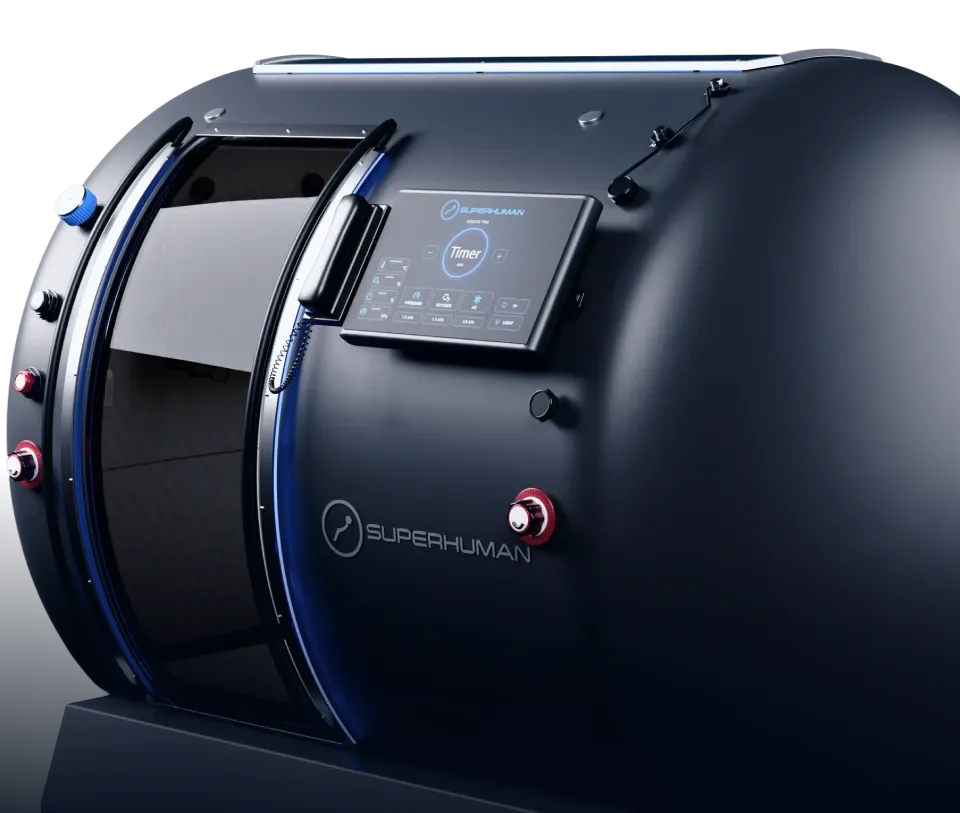 Multi-Person Hard-Shell Superhuman T4 Four occupants at 2.0 ATA, clinical-scale throughput for a recovery program Pressure Up to 2.0 ATA Capacity 4 people Format Seated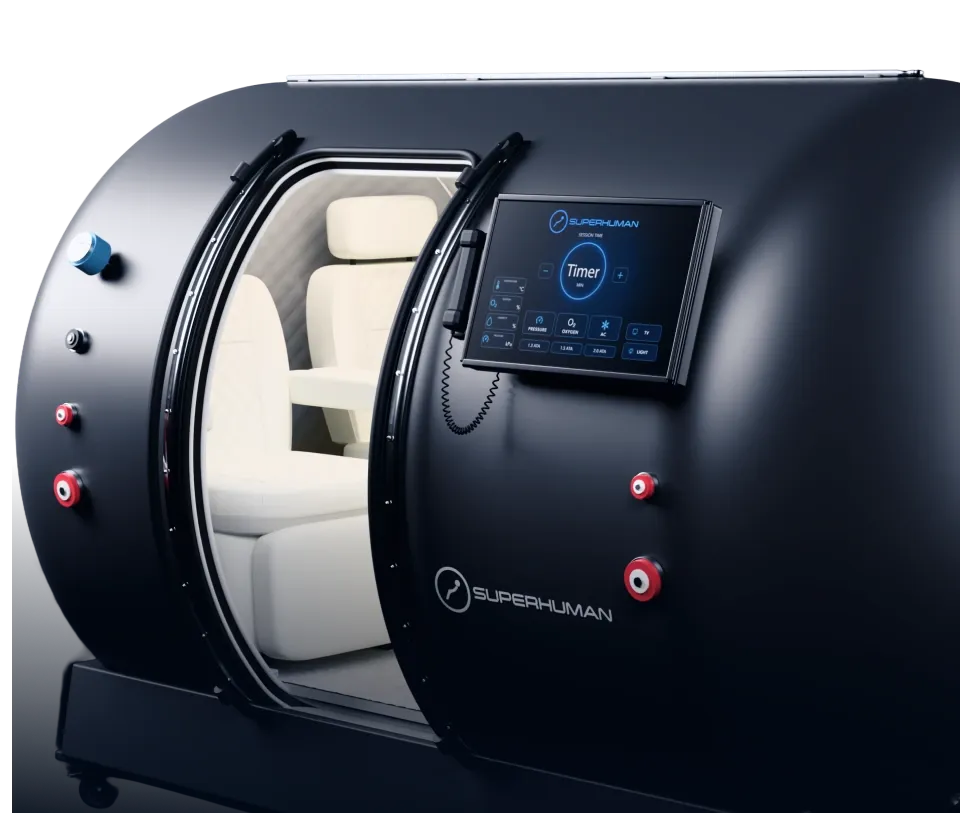
Scoping a chamber for a clinical, aesthetic, or wellness operation? Book a consultation, or see the numbers in our financing and payments guide. For anything related to an actual post-operative patient, the path runs through the surgical team, not through equipment of any class.
For wellness operators
What you can say, and what you must not claim
Post-surgical clients will find your chamber in the most motivated weeks of their recovery, and some of them should not be anywhere near it without their surgeon. The compliant answers are short, the referral is the product, and staying inside these lines protects the client and the business.
| You can say | You must not claim | |
|---|---|---|
| Talking about post-surgical recovery | HBOT is not FDA-cleared for general surgery recovery; the controlled evidence is thin and mixed, and research continues | That your sessions speed up healing, reduce swelling, or shorten downtime after any specific operation |
| A post-op client asks | Send them back to their surgeon for clearance first; the operating team owns the post-op window | Booking sessions for someone whose surgeon has not signed off, or advising them to skip a follow-up |
| A failing graft or flap | Treat it as a surgical emergency: the client calls their surgeon today; salvage HBOT is physician-directed and time-critical | Any wellness-chamber role in a compromised graft or flap. That case belongs to a hyperbaric physician, not your studio |
| Pressure honesty | State your chamber's rated pressure and that the published protocols ran at 1.6-3.0 ATA on hard-shell clinical equipment | Citing the salvage or facelift studies as if they were produced at 1.3 ATA in a soft chamber |
One script covers the conversation that matters most. "I have a facelift next month. Will this help me heal faster?" The honest answer: nobody gets to promise that, and the studies behind the marketing are small, uncontrolled, and unblinded; the only one run properly against a sham control in this whole field has not been done yet. What we can do is show you the full record, and the first call after this one should be to your surgeon, because the weeks after your operation belong to them. An operator who says that out loud will lose some package sales and keep every bit of trust, and with this audience, trust is the only asset that compounds.
The patient's checklist
If you are considering HBOT after your surgery
Off-label does not mean off-limits; it means the burden of diligence moves to you and your surgeon. Here is the diligence, in checklist form.
Ask the surgeon first
Not the chamber provider: the surgeon. They own your post-operative window, they know what your tissue looks like, and they carry the responsibility if a session interferes with drains, dressings, medications, or follow-up. Three questions make that conversation concrete. Is there any medical reason I should not be in a pressurized chamber, given my operation and my history? Is my recovery actually on track, because if something is wrong, the answer is your care, not a wellness purchase. And if they are neutral: is there any evidence for my specific operation, or is this an extrapolation? A provider worth paying will welcome all three questions in writing.
Questions for the provider
Which protocol, exactly? Pressure in ATA, minutes at pressure, total sessions, and what it is extrapolated from. Who screens me, and against what? A clinician who asks about your operation, your ears, your lungs, and your medications, or a waiver and a technician. What is the total itemized cost, in writing, including what happens if you stop early. And the question that separates honest providers from marketers: what do you tell people the evidence actually is? One who answers "promising but unproven, and your surgeon should sign off" has done the reading. One who answers with a percentage has not.
Red flags, audited against the literature
"FDA approved for surgical recovery": false; the only cleared post-surgical use is salvage of a compromised graft or flap, and that is hospital medicine. Salvage statistics sold as recovery promises: the 89-91% figures are dying tissue rescued in a medical setting, not facelifts healing faster, and the UHMS says the therapy is not recommended for normal tissue. "Studies show wounds heal three times faster": that number is 20 unrandomized patients from one practice (Neel 2023). Urgency pressure and pay-in-full packages: routine recovery has no clock; only salvage does, and you would be in a hospital for that. Any suggestion to skip a follow-up or substitute sessions for aftercare: walk out.
Honest edges
Limitations and open questions
The evidence is real where it is real and thin where it is thin. Both halves deserve the same clarity, including the parts that cut against this page's own caution.
Start with the weaknesses in the cautious case, because fairness demands it. The negative signals are not strong either: the Cochrane "unclear" verdict rests on four small, biased trials, the 2026 pooled analysis leans in HBOT's direction even without reaching significance, and the knee trial genuinely found less pain, swelling, and muscle damage in the hardest measured days after surgery, with zero added adverse events. If a procedure-specific, adequately powered trial ever runs, it may well find a real early benefit worth paying for. The honest summary is not "HBOT does nothing after surgery." It is: nobody has run the trial that could prove what it does, and the market sells as if that trial already happened.
The weaknesses in the positive case run deeper, though. The salvage numbers are decades old and uncontrolled. The cosmetic numbers come from designs that cannot separate the treatment from time, expectancy, and the fact that everyone heals. The one preconditioning cohort with a striking result was run by a single research group with commercial ties to hyperbaric medicine, on patients who chose and paid for the therapy, at a dose of one to three sessions that has never been replicated. None of this is scandalous. All of it is exactly the pattern that demands procedure-specific, sham-controlled randomized trials before anyone calls recovery a proven use.
What would settle the question is known: trials that compare HBOT against a convincing sham, one operation at a time, with healing time, complication rates, and patient-reported outcomes measured by blinded assessors, the design every recent review on this page explicitly demands (Mortada 2025; Molina-Vega 2026). Until they report, the fair verdict for a patient is: plausible, unproven, not covered, and never a substitute for your surgeon's care. And one closing fact this page is built on: whatever the answer becomes, it will be decided at hard-shell pressure with 100% oxygen under medical supervision, the dose class every serious protocol in this literature used. For the adjacent condition where that class of treatment is already established and covered, see the wound healing and HBOT pillar; the contrast between the two pages is the most honest sentence we can write about this one.

FAQ
Surgery recovery and HBOT questions
Is HBOT FDA-approved for recovery after surgery?
No. Hyperbaric chambers are FDA-cleared for 13 indications (carbon monoxide poisoning, decompression sickness, non-healing diabetic wounds, radiation injury, and others), and general post-surgical recovery is not among them. The one surgery-adjacent use that IS cleared is the rescue of a compromised skin graft or flap, where the FDA has cleared chambers for marketing, the UHMS lists it as indication #12, and Medicare covers it. Every other post-surgical use, including cosmetic-surgery recovery packages, is off-label. Any clinic page describing HBOT as approved for surgical recovery is misstating the record.
Does insurance or Medicare cover HBOT after surgery?
Only for the salvage indication, not for recovery. Medicare's NCD 20.29 covers the "preparation and preservation of compromised skin grafts," with an explicit parenthetical: not for primary management of wounds. That sentence is the payer's own line between saving threatened tissue (covered, surgeon-directed) and helping a normal recovery along (not covered). Routine post-surgical and cosmetic-recovery courses are cash-pay everywhere in the US. Our insurance coverage guide, linked on this page, explains how the covered indications work, and the CPT guide covers the billing codes for the salvage side.
Can HBOT speed up healing after a facelift, tummy tuck, or liposuction?
The honest answer is: maybe, and nobody has proven it. The only facelift-specific comparative study (20 patients, one practice, no randomization) found wounds healed in 13.3 days with HBOT versus 36.9 without. A 296-patient aesthetic-surgery series reported quick recoveries but had no control group, and its own authors wrote that they could not prove effectiveness. A 2025 meta-analysis pooled a mean healing time of 11.3 days across 734 patients while demanding proper randomized trials. The physiology is plausible and the early data is interesting, but these are the weakest study designs in medicine applied to a recovery that would happen anyway. If you want to try it, clear it with your surgeon first and treat any faster-healing promise as unproven.
How many sessions do the studies use, and what does a course cost?
There is no standardized recovery protocol; the facelift study's authors state that no agreed session count exists. The published numbers scatter widely: the knee-replacement trial used just 2 sessions at 1.6 ATA, aesthetic practices sell 5-session packages at 2.0 ATA, the facelift study averaged 7 sessions, and graft/flap salvage runs 20-30 sessions at 2.0-2.4 ATA, sometimes twice daily. Off-label recovery courses are cash-pay; the 2026 plastic-surgery review reports per-session prices of $150-650 in the literature. Before buying any package, get the protocol (pressure, minutes, session count) and the total itemized cost in writing, and ask what evidence supports that specific dose for your specific operation.
Is a home soft chamber the same treatment the studies used?
No. Every study on this page used a hard chamber delivering 100% oxygen at 1.6 ATA or higher, most at 2.0-2.5 ATA, under supervision. Soft portable chambers operate around 1.3 ATA, typically fed by an oxygen concentrator rather than 100% medical oxygen, and their FDA clearance covers acute mountain sickness only. Dissolved plasma oxygen, the proposed mechanism for every claim on this page, scales with pressure, so a mild-pressure home session is a different, unstudied dose, not a cheaper version of the studied one. If a seller quotes the graft-salvage or facelift data while proposing a soft home unit, ask which study was run at that pressure.
How soon after surgery can I start, and who should not use a chamber?
Both halves of that question belong to your surgical team, not to a chamber operator. Timing: in the salvage literature, earlier is better (the failing graft has an hours-to-days window), while for elective recovery there is no studied optimal start time at all. Screening: the one absolute contraindication is an untreated pneumothorax; recent ear, sinus, head, neck, or chest surgery changes the risk picture because pressure equalization and trapped air behave differently in healing tissue; drains, wound devices, and implanted hardware all need device-specific answers from your care team. And the rule that overrides everything: HBOT never replaces or delays standard post-operative care. Fever, spreading redness, a wound opening, or discharge means call your surgeon, not book a chamber.
Last updated: October 2026. This guide is educational and is not medical advice. Hyperbaric oxygen therapy is not FDA-cleared for general surgery recovery, and any recovery use is off-label. The cleared salvage indication for compromised grafts and flaps is physician-directed hospital medicine. Never delay or substitute standard post-operative care; for any warning sign after surgery, contact your surgical team first. Any choice about HBOT in the post-operative period belongs with your surgeon and treating physicians, who can weigh it against your operation, your history, and the full trial record.