

Buying guide · cost comparison
Home Hyperbaric Chamber vs Clinic Sessions: The Real Math
A clinic session costs $100 to 250. A home hard-shell chamber costs $49,900 to $99,900, plus about $400 a year to run. Which side of that trade wins depends on three things: your session price, your weekly frequency, and how many people share the chamber. Here is the honest arithmetic, including the situations where the clinic is the right answer and we say so as a company that sells chambers to clinics too.
The short answer
Three verdicts, before the math
This page is a numbers page, not an argument against clinics. Clinics are the right answer for a defined set of situations, ownership for another, and the boundary between them is arithmetic, not opinion.
The clinic wins when the need is medical or short
A diagnosed condition on the FDA-cleared indication list, a physician supervising your care, insurance covering the course, or a one-time need of a few weeks: in all of these, paying per session at a facility is not just cheaper, it is the correct setting. We say that as a company that sells chambers to those clinics.
Owning wins when use is frequent and long-term
Daily or near-daily wellness and recovery use, more than one person in the household, a horizon measured in years. At clinic prices of $100 to 250 a session, a daily user spends a hard-shell chamber's price in about 12 to 24 months, and keeps going after the payments stop.
The honest middle: run your own numbers
The crossover depends on three things only: your local session price, your real weekly frequency, and how many people share the chamber. This page works the arithmetic at both ends of the price range so you can place yourself on it, then links the calculator for your exact case.
Two disclosures frame everything below. First, we manufacture chambers and sell them to both sides of this comparison: to families for their homes and to the clinics you might pay per session. That is exactly why this page can be balanced; we have no interest in steering a medical patient out of supervised care, and every reason to be precise about where each path wins. Second, the two paths are not the same product. A clinic sells supervised treatment sessions. A home chamber sells unlimited access. Comparing their sticker prices without comparing what a year of each actually looks like is how people get this decision wrong in both directions. New to the therapy itself? Start with how hyperbaric oxygen therapy works, then come back for the money.
The pay-per-use side
What a clinic course actually costs
Clinic pricing is quoted per session, which keeps the number small. A course is sessions multiplied by weeks, plus travel and time, and the total rarely appears on a price list.
| Line | Cost | Where the figure comes from |
|---|---|---|
| Per session, wellness / recovery clinic | $100 to 250 | The cash-pay range across US wellness clinics (our cost guide figures) |
| Per session, off-label medical clinic | $230 to 450 | Veteran advocacy tracking of cash-pay medical clinics (attributed) |
| Medicare-allowed, covered indication | $595.86 | Facility + physician components; the patient pays ~20% Part B coinsurance |
| A 20-session block at $200 | $4,000 | A common introductory package |
| A 40-session course at $200 | $8,000 | The studied-course length most clinics quote |
| A 60-session course at $200 | $12,000 | The long research protocol, three months of weekdays |
| One year of daily use at $200 | ~$52,000 | 5 sessions a week, 52 weeks: the number that reframes the question |
Two different clinics, two different prices
The $100 to 250 range covers wellness and recovery clinics: recovery lounges, longevity studios, sports facilities. Off-label medical programs run higher; the veteran advocacy coalition tracking access nationally puts cash-pay medical clinics at roughly $230 to 450 a session. Neither is covered by insurance, because insurance covers HBOT only for the FDA-cleared indication list. For those covered indications the economics are completely different: Medicare's allowed amount is $595.86 per session, of which an insured patient typically pays about 20% as coinsurance (NCD 20.29). The full payment mechanics are mapped in our insurance coverage guide.
The costs that never appear on the price list
A session is 60 to 90 minutes inside the chamber, but the appointment is half a day: the commute both ways, the wait, the change of clothes. At five sessions a week, a daily protocol costs ten or more hours of logistics a week on top of the chamber time, which is the part of clinic attendance that breaks routines and, with them, results. Protocols also cluster into packages: 20- and 40-session blocks are the common units, and a 40-session block at $200 is $8,000 committed before you know whether the routine suits you. None of this is an argument against clinics; it is the full price of the pay-per-use path, which the breakeven section below sets against the full price of owning.
The ownership side
What owning a chamber actually costs
One purchase price, then a running cost small enough that most buyers misplace it. Every figure below comes from our published cost, maintenance, and installation guides, linked at the end of the section.
The chamber
The one-time line: $15,000 (soft-shell S1), $49,900 (hard-shell L1), or $99,900 (two-person T2). Home use means the S1-to-T2 range; the $169,000 four-person T4 is a clinic system.
Delivery, install, training
On every Superhuman hard-shell this line is $0: white-glove delivery, professional installation, calibration, and same-day training are included. Elsewhere it can arrive as a second invoice.
Power and oxygen
A standard household outlet runs the chamber and its oxygen concentrator; no plumbing, no construction. About $1.50 to $2 of electricity per session, and nothing to refill: oxygen comes from the concentrator, not tanks.
Maintenance per year
Published market ranges run $300 to 800 (soft) and $1,500 to 6,000 (hard) per year. Superhuman owners average about $400 all-in: $200 to 300 of filters plus a service buffer, with no proprietary consumables.
The structure matters more than the numbers. Clinic spend is a pure expense: every dollar buys one session and retains nothing. Ownership is a fixed asset plus a small running cost: a 304 stainless hard-shell is built for a 20 to 30+ year service life, and a documented chamber typically retains 50 to 65% of its purchase price after five years (market resale guide, attributed). The asset-economics detail, including warranty terms and what drives resale value, is on the lifespan, warranty, and resale page.
For the monthly reality rather than the sticker: a $49,900 L1 financed over 60 months at an illustrative 9.9% runs about $1,058 a month, and a $99,900 T2 about $2,118, both below what a daily clinic habit costs at mid-range prices. Financing is arranged through third-party lenders, so those are illustrations, not offers; the financing guide works the full payment tables, and the cost calculator models your own usage. What living with one involves day to day (space, noise, routine) is covered in the installation guide and the home chamber guide, and the upkeep detail is in the maintenance and service guide.
The crossover
The breakeven math, three scenarios
Illustrative arithmetic at a $200 clinic session (mid-range) against real list prices and real running costs. Where your local price or frequency differs, the crossover moves, and the notes under each scenario say which way.
| Scenario | Usage pattern | Clinic spend | Ownership spend | Verdict |
|---|---|---|---|---|
| Scenario 1: one person, one course | A physician-set or self-set course of 40 sessions, then done | $8,000 (40 × $200) | $49,900+ for an L1, before any running cost | Clinic, clearly. A defined short course has an end date; a purchase does not justify itself inside one. |
| Scenario 2: one person, daily, long-term | 5 sessions a week (260 a year), wellness and recovery, years of use | Year 1: ~$52,000 · Year 5: ~$260,000 | Year 1: ~$50,820 ($49,900 + upkeep + power) · Year 5: ~$54,500 | Owning crosses over inside year one at $200/session. At $150 a session the L1 breaks even around month 16; at $100, around month 23. |
| Scenario 3: a couple, sharing a T2 | Two people, 10 combined sessions a week (5 shared dives), long-term | Year 1: ~$104,000 · Year 5: ~$520,000 (clinics bill per person) | Year 1: ~$100,820 ($99,900 + upkeep + power) · Year 5: ~$104,500 | Owning crosses over around month 12. Two seats halve the dive count, which is why households tip the math fastest. |
Ownership spend = list price + ~$400/yr upkeep + ~$2 electricity per dive, from our cost and maintenance guides. Clinic spend = sessions × $200, mid-range of the published $100 to 250. Financing changes the timing, not the totals: the same chambers at an illustrative 9.9% over 60 months run $1,058/mo (L1) and $2,118/mo (T2). Resale value is excluded from these rows, which understates ownership: a documented five-year-old chamber typically retains 50 to 65% of its price.
Reading the table honestly
The three inputs that move the answer are price, frequency, and heads. Price: at $150 a session the single-user breakeven stretches from 12 to about 16 months; at $100, to about 23. Frequency: a twice-a-week user never reaches the crossover inside five years, and for that user the clinic, or a rental at $500 to 1,000 a month for a defined block, is the rational path. Heads: clinics bill per person, so every additional household member moves the crossover toward owning faster than any other variable. The family of three doing recovery sessions is not an edge case of the math; it is the case the math was made for.
What the table deliberately leaves out is the adherence effect: people who own a chamber do more sessions than people who book them, because the friction is gone. That cuts both ways. It is the strongest argument for owning, and it is also the reason to try a clinic block first if you have never done HBOT: twenty sessions answer whether the routine survives contact with your working week before five figures do. Run your own inputs in the cost calculator before deciding either way.
Said plainly
When the clinic is the right answer
We sell chambers to clinics as well as to homes, so we can say this without a conflict: there are situations where paying per session at a facility is not the expensive option, it is the correct one.
A medical indication that belongs to a physician
Hyperbaric chambers are FDA-cleared for a defined list of conditions: non-healing diabetic wounds, carbon monoxide poisoning, decompression sickness, radiation injury, and others (FDA, archived; UHMS indications). Treatment for those conditions is physician-supervised medical care, delivered in accredited facilities, typically at 2.0 to 2.4 ATA with medical oxygen and a trained team, and frequently covered by insurance, which means the economics flip entirely: the clinic is the funded pathway and a home purchase is the unfunded one. If that is your situation, this page's math does not apply to you, and the right next step is your physician and a covered facility, not a purchase. Our wound healing pillar covers the flagship covered indication, and the insurance guide covers how payment works there.
A one-time or acute need
A defined course with an end date, set by a treating physician or chosen as a trial, has no business becoming a purchase. Twenty or forty sessions at clinic prices is $4,000 to $10,000, a fraction of any chamber, with nothing to install, maintain, or resell afterward. Scenario 1 above exists to say so in numbers.
Your first exposure to HBOT
Nobody should buy a chamber to discover whether they like using one. A clinic block answers the questions a spreadsheet cannot: whether the pressure suits your ears, whether claustrophobia is a factor, whether the routine survives a working week. Many of our home buyers came through exactly that door, and it is the right door.
Care that needs a team, not just a chamber
Clinical programs bundle the things a home setup does not have: screening for contraindications, a physician adjusting the protocol, staff present during sessions, and somewhere to take a problem the day one appears. For anyone with a significant diagnosis, those are not amenities. The equipment-class context for what medical-grade actually means is in our medical-grade chambers explainer.
The other half of the answer
When owning wins
The uses with no end date are the uses where pay-per-session never stops. Six reasons the math and the lived experience both tip toward a chamber of your own.
Frequency and time
A 60-minute session at home replaces half a day of booking, commuting, and waiting rooms. Most home users settle into 3 to 5 sessions a week because there is nothing to schedule.
More than one user
Clinics bill per person; a chamber serves the household from one purchase. A two-person model turns a couple's combined clinic bill into a fixed cost.
Long-term wellness use
Recovery, sleep, performance, longevity: the uses with no end date are exactly the uses where paying per session never stops. Owning converts a recurring cost into a fixed one.
Privacy and convenience
Your own chamber, your own schedule, 6am or 10pm, no shared equipment and no small talk. For many buyers this is worth more than the arithmetic.
An asset, not an expense
A 304 stainless hard-shell is built for 20 to 30+ years, and a documented chamber typically retains 50 to 65% of its purchase price after five years. Clinic receipts retain nothing.
Adherence is the real ROI
The unglamorous truth of HBOT research is that protocols are long and consistency is the hard part. People who own a chamber simply do far more sessions than people who book them.
The home-use side of this decision, who buys and what living with a chamber involves, is covered in depth on the home hyperbaric chambers guide and the for-home overview. This page stays on the math.
If the math points to owning
The two chambers this decision usually ends in
For a single daily user, the L1. For a couple or family, the T2. Prices stated plainly, with the financing and pre-tax routes that change what the sticker means.
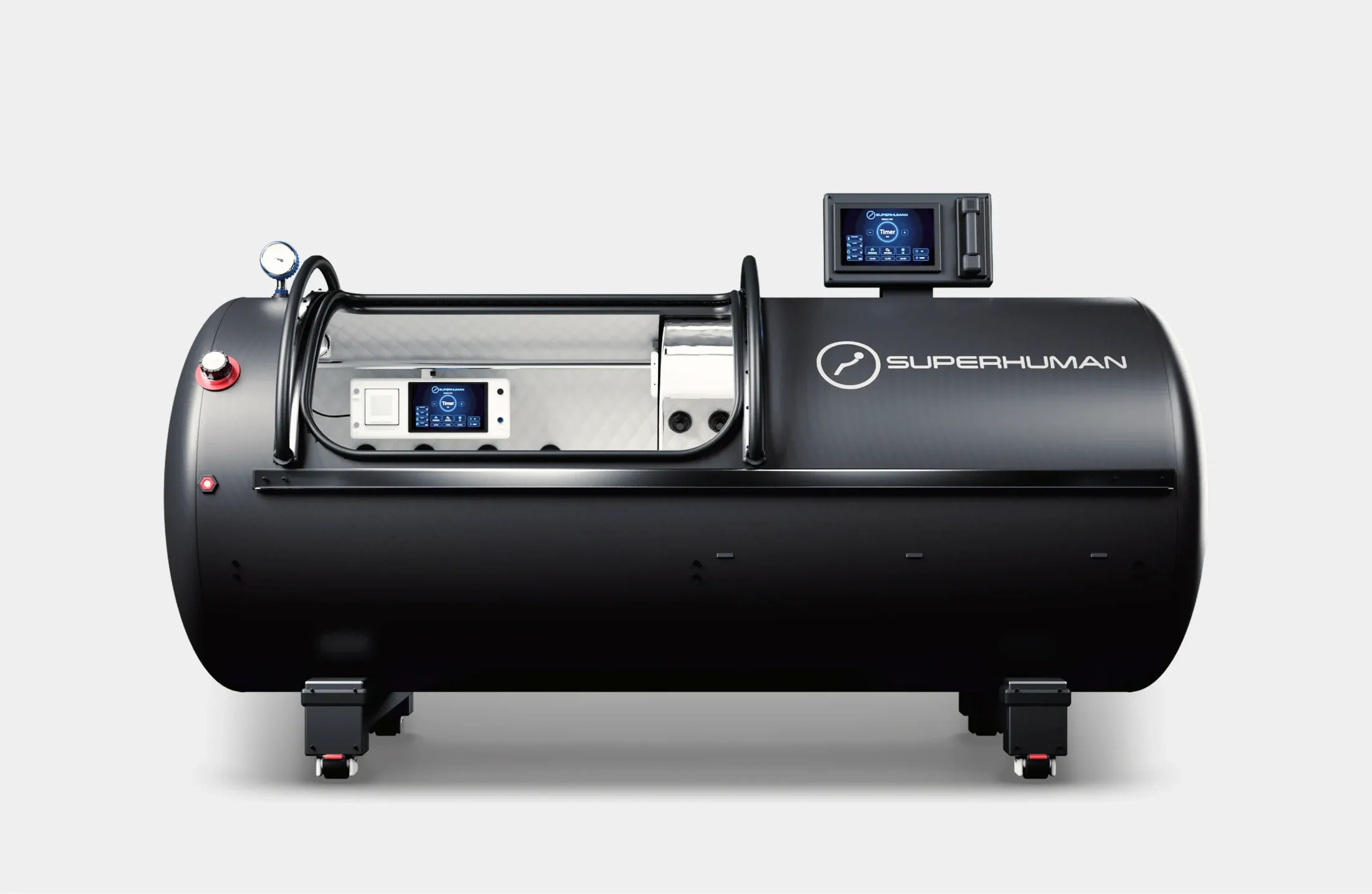
Superhuman L1: full 2.0 ATA pressure, 20 to 30 year steel shell, delivery, install, and training included
Superhuman L1, $49,900 · about $1,058/mo financed →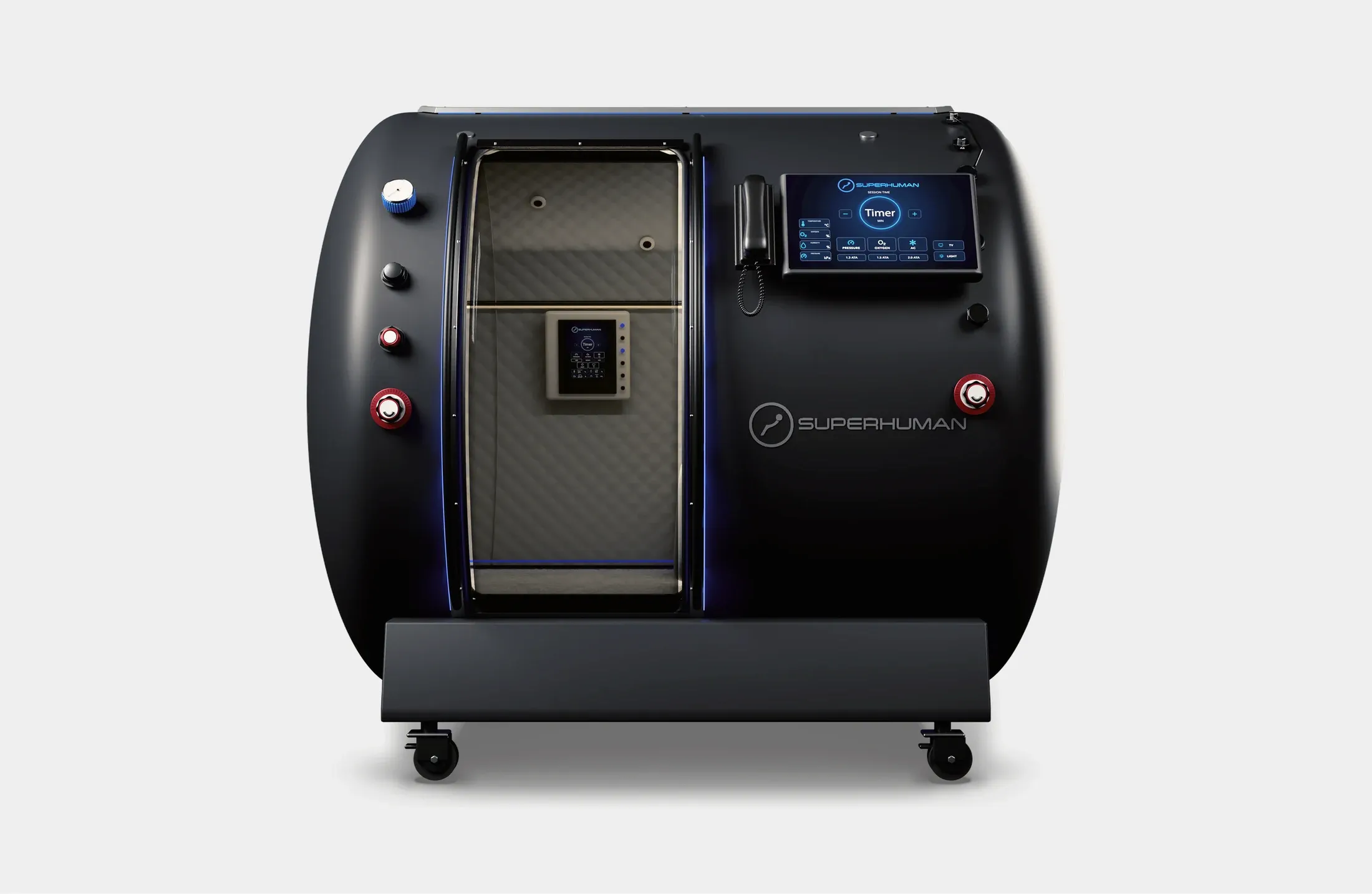
Superhuman T2: two seats at full pressure, the model that halves a household's dive count
Superhuman T2, $99,900 · about $2,118/mo financed →The honest framing on both prices. $49,900 and $99,900 are real numbers, and we do not pretend otherwise; the case for them is the arithmetic above, not a discount. Three things change what the sticker means. Financing: the monthly figures above are 60 months at an illustrative 9.9% through third-party lenders, and the financing guide prints the full tables including total interest. HSA/FSA: qualified buyers paying through Truemed with pre-tax HSA/FSA dollars save an average of 30% (Truemed disclosures), which moves the breakeven months earlier. And resale: a documented five-year-old chamber typically retains 50 to 65% of its price, so the net cost of ownership is lower than any row above shows. Running a clinic rather than comparing against one? The four-person Superhuman T4 at $169,000 is the clinical-throughput model, and the cost calculator has an operator ROI view.
FAQ
Clinic vs owning questions
Is it cheaper to buy a hyperbaric chamber or keep paying a clinic?
It depends on frequency and horizon, and the crossover is computable. Clinic sessions commonly run $100 to 250 each. A $49,900 hard-shell with about $400 a year of upkeep and roughly $2 of electricity per session breaks even against a $200 clinic price after about 250 sessions, which a daily user reaches inside year one. For a single defined course of 20 to 40 sessions, the clinic is far cheaper. The further your use is from daily and long-term, the more the clinic wins; the closer, the more owning does. The cost calculator on this site runs the crossover for your exact usage.
How many sessions does it take for a home chamber to pay for itself?
Against a $200 session price, a $49,900 hard-shell breaks even around 250 sessions and a $99,900 two-person chamber around 510 person-sessions, which a couple sharing five dives a week reaches in about 12 months. The range matters: at $150 a session the single-user breakeven stretches to roughly 330 sessions (about 16 months of daily use), and at $100 to about 500 sessions (around 23 months). These are illustrations at mid-range pricing, not quotes; your local clinic price is the input that decides it.
Does insurance cover clinic HBOT, or a home chamber?
Clinic treatment, sometimes; a chamber you buy, essentially never. Insurance and Medicare cover hyperbaric oxygen therapy only for the FDA-cleared indication list (non-healing diabetic wounds, carbon monoxide poisoning, radiation injury, and others), delivered in a facility under physician supervision, often with prior authorization. Medicare's allowed amount is $595.86 per session, of which the patient typically pays about 20% as Part B coinsurance. Wellness, recovery, and performance sessions are not covered anywhere, and no insurer reimburses the purchase of a home chamber. If your need is a covered medical indication, the clinic pathway is the funded one, and that is where you should be.
When should I choose a clinic instead of buying a chamber?
In four situations, stated plainly. First, a diagnosed condition on the FDA-cleared indication list: that is physician-supervised medical treatment, often insurance-covered, and it belongs in a medical facility. Second, any acute or one-time need with an end date, where a purchase cannot justify itself. Third, your first exposure to HBOT: a few clinic sessions answer questions no spreadsheet can, including whether the routine suits you. Fourth, when you want a protocol above home-chamber pressure or staffing: clinical facilities run 2.0 to 2.4 ATA with medical teams. We sell chambers to clinics as well as to homes, and this is the honest split between the two.
Can I use HSA or FSA money to buy a home hyperbaric chamber?
Sometimes, with documentation. HSA and FSA funds can pay for equipment used to treat, mitigate, or prevent a diagnosed medical condition, which in practice means a letter of medical necessity. We partner with Truemed: qualified customers complete a short survey, receive a letter from an independent provider where appropriate, and pay with pre-tax dollars, saving an average of 30%. Eligibility is determined by the provider and your plan administrator, not by us. Pure wellness use without a qualifying diagnosis generally does not qualify.
What does a home chamber cost to run each year?
Less than most buyers expect. Electricity is about $1.50 to $2 per session. Maintenance on a Superhuman chamber averages about $400 a year all-in: filter changes of $200 to 300 plus a service buffer, with no proprietary consumables and no oxygen to refill, because the chambers are air-pressurized and a concentrator supplies the oxygen. Delivery, installation, and training are included in the purchase price of every hard-shell, so there is no second invoice. A five-year-old documented chamber also typically retains 50 to 65% of its purchase price, which belongs in the math as well.
Last updated: September 2026. This page is educational and is not medical or financial advice. Clinic prices are published market ranges; financing figures are illustrations through third-party lenders, not offers of credit. Hyperbaric oxygen therapy for FDA-cleared indications is physician-supervised medical care, and any treatment decision for a diagnosed condition belongs with your treating clinicians.